





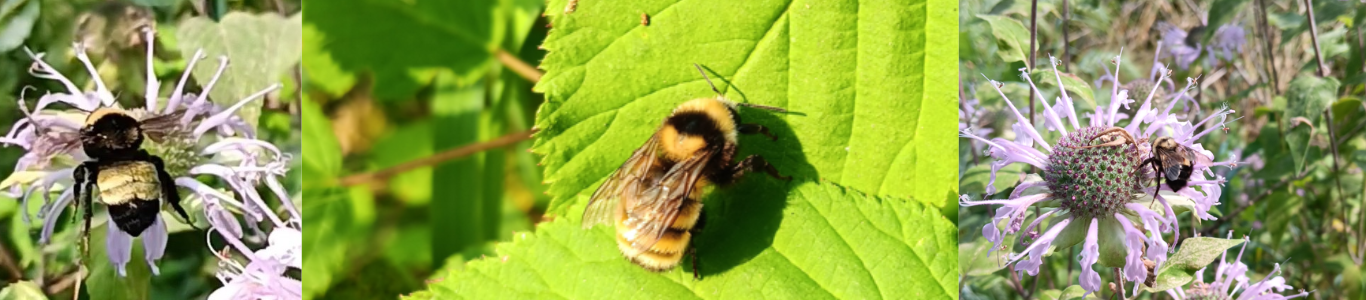


Finding a federally endangered bumblebee species during her capstone project wasn’t just a rare moment in the field—it was proof that Morgan Geary’s restoration work with the Wisconsin Department of Natural Resources was making a measurable difference.
Morgan, a student in the Master of Science: Biodiversity Conservation and Management program through UW-Green Bay, wanted to use her master’s capstone project to gain knowledge she could directly apply in her role with the Green Bay office of the Wisconsin DNR. She studied the diversity of bumblebee species at her sites – keeping in mind that her study could be replicated for future use cases.
“That was really cool to just see the impact that the everyday work that we are doing and the management practices are benefiting the pollinators,” she says. “I was noting what bee species I caught off what flower so that I could further tie species to flower type. And then over time, if it’s a continued project on the same sites and on the same survey locations, they could see how the habitat restoration is impacting the species by providing more floral resources, assessing the availability of floral resources at different times of the season, and helping guide management that way.”
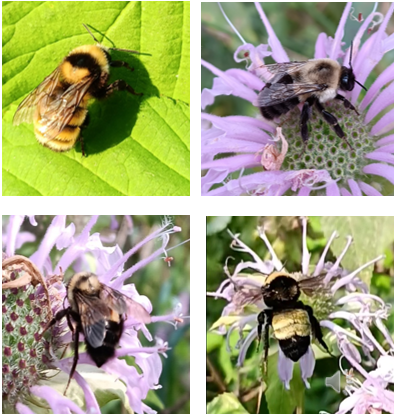
Mapping Bumblebee Diversity in Action
Bumblebees are critical to our environment – without pollinators like them, we wouldn’t have many of the foods, beverages, fibers, spices and medicines that we use daily. Rusty patched bumblebees, which are among the species Morgan studied, are capable of “buzz pollination,” which means they deposit more pollen than other insect pollinators. They also pollinate over a longer period of the day and can pollinate in harsher conditions – like lower temperatures. They have longer tongues as well, so they can pollinate flowers with deep and narrow corollas like cranberries, blueberries and tomatoes – all of which are important crops in Wisconsin.
Conservation partners like the DNR are working to recover the species through targeted recovery actions including restoring nesting, foraging and overwintering habitats, investigating solutions to threats, and research and monitoring. These activities are directly related to the work Morgan completed with her habitat restoration capstone project.
Morgan began her project by completing opportunistic surveys in June and July, and then more formal surveys in August. Her colleagues helped with the record keeping and surveys at these sites and volunteers with the Bumble Bee Brigade were instrumental in her success.
“I recorded the transect length and followed more of the procedures that the species experts at the DNR had given to me, just to keep that part more structured,” she says. “[In] August when it was peak floral abundance, we could get the most diversity and really interpret that.”
She spent the fall semester of 2025 putting the entire project together, including maps and data analysis. Morgan estimates that she spent about two hours a week on her surveys, which includes the time spent surveying and uploading photos to confirm her observations. From there, she spent roughly an hour a week on the actual report and the data analysis. During this time, she was also taking another BCM course to stay on track for graduation.
Morgan received the results she expected, and her project was well-received.
“My professor seemed to really love the whole concept, and she was very excited about the project. And then from my mentor’s standpoint at the DNR, he was seeing the benefit of it in the continued approach and getting to see that change over time. So he was very receptive to it as well.”
Morgan benefited from being able to work on her project as part of her workday. “Otherwise, I think it would have added a challenge of trying to find the time to do my classes, work full-time, and then set aside additional time to go do these surveys. So it was a huge benefit being able to do this as something that can benefit my current employer and myself in one swoop.”
Students in the Biodiversity Conservation and Management program are encouraged to design their capstone projects around their personal interests and professional development goals. The capstone instructor is available to support students throughout the process, whether they choose to complete projects based in a professional, laboratory or field setting.
Morgan plans to expand her project to enhance her current work. She’s since started a new job with the city of Green Bay Conservation Corps as a field assistant, where she supervises AmeriCorps members.
“They go out and serve on different properties around the City of Green Bay, removing invasive species, and other habitat restoration. But there’s more of a community-engagement aspect related to the position as well, which this program has helped bridge those gaps because it focuses so much on the human dimensions of conservation and more of those skills that I wasn’t getting in previous positions, like the grant writing and that official leadership role. So it’s very similar [to my previous role], but it’s more of a transition to the community engagement aspect and less doing conservation for the species.”
A Lifelong Interest in Nature
Morgan has two brothers who were involved in Boy Scouts, and both her parents were Boy Scout leaders. When she was old enough to participate in Girl Scouts, her mom began working with them as well. While Morgan spent her early childhood years in Illinois, eventually, her family moved to Door County, Wisconsin.
“We had a county park as basically our backyard,” she says. “I spent so many hours in the woods, at the creek and in the bay just exploring and learning more about nature.”
Morgan was undecided on her career path until one day in high school when her mom suggested she pursue natural resources.
“I didn’t even know you could do that. And so that’s really what got me interested in conservation; I can make a career out of what I love,” she says.
Morgan completed a bachelor’s degree in ecology and conservation biology from UW-Green Bay. During her undergraduate studies, she interned with the Fish and Wildlife Service in Indiana and worked several seasonal positions with the DNR. She landed her first full-time role with the DNR in Alma, Wisconsin, working with threatened and endangered species and habitat restorations. After her role in Alma, she moved back to Green Bay to work for the DNR in a similar capacity, which is when she knew she was ready for a master’s degree.
Pursuing a Master’s in Biodiversity Conservation and Management as a Bridge to a More Fulfilling Career
Morgan’s motivation for earning her master’s was to fill some of the knowledge gaps she felt she had in her positions. She chose Biodiversity Conservation and Management because it was 100 percent online and accessible for someone working full-time. She picked her capstone project on bumblebees based on an experience she had at the Green Bay DNR office where she took a short course at UW-Green Bay on bumblebee identification.
“Not having this knowledge is the difference between me getting to advance my career but also not having the current opportunities to do it where I am. It helped me make that bridge so that I could make that transition smoother.”
Morgan advises prospective students to really think about what they want to do with their careers. “How can this program help you so that you really have a purpose for being there beyond just expanding your education? How is it going to build you as a person to reach your next level?”
“I think it’s a great program. It really benefited me. And I think that if you have your reasoning for being there, then whoever embarks on the same program would get what they want out of it. [During my undergrad], I had a psychology teacher who said, ‘We don’t have tests. I want you to get out of this class what you want to get out of this class.’ And that’s always stuck with me is that you’re going to get out of every opportunity and situation that you want to get out of it.
“I’m in my last semester of the program…I really value that I’m getting out of it what I want. And I’m not sitting down to memorize and study and pass exams. I’m actually learning and retaining. I really value the group discussions, the discussion boards and the format of the course. That helps make it accessible.”
Are you interested in learning how the Biodiversity Conservation and Management program can help you transition into a new career or enhance your current path? Contact an enrollment adviser today.