







UW-Green Bay, the home campus for the newly launched Master of Science in Biodiversity Conservation and Management, has a long history of ecological awareness and advocacy. Once dubbed “Eco U,” the campus has always embraced a community and environmentally-minded approach to education.
Ed Weidner, UW-Green Bay’s first chancellor, coined the term “communiversity” during his tenure in the 1970s. He exemplified the university’s original vision to be ecologically focused when it opened its doors on a 600-acre campus on the southern end of Green Bay in 1969.
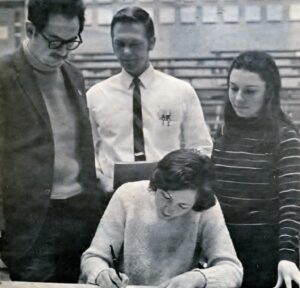
UW-Green Bay’s mission, as articulated in 1968, was parallel to that of other University of Wisconsin campuses, but with an ecology lens: “The academic plan of UW-GB is based upon a specific educational philosophy. In essence, it begins with people–especially students–and the world in which they live.”
The mission also noted that students were to be full participants in their education through numerous off-campus activities to help them better understand the environment and the crises it faces.
UW-Green Bay began making history as “Eco U” through its participation in the first Earth Day march on April 22, 1970, alongside St. Norbert College and Green Bay Preble High School. Earth Day was founded by then-Wisconsin Gov. Gaylord Nelson to raise awareness about air and water pollution. It’s now observed worldwide and commemorated as a month of recognition, stewardship and celebration of the environment.
UW-Green Bay’s campus was relatively new when Earth Day took place, but the campus sprang into action to make it memorable. Students and faculty arranged a “Survival 70’s” program with an environmental teach-in. Student Kathy McDonough Gerds, chairperson, said later: “Earth Day brought us together at UWGB as a student body for the first time. It gave us a common cause. “
As part of the first Earth Day observation, UW-Green Bay students prepared a petition calling for “an amendment to the state constitution that would preserve a healthy environment for future citizens.” UW-Green Bay mailed the petition to 75 Wisconsin universities, colleges, and technical schools. Once completed, the petition was forwarded to the Wisconsin governor and legislators.
UW-Green Bay also piloted early recycling programs on campus, and launched a Mobile Center for the Study of the Environment (MSCE) eco-van in spring 1973. Funded by the Ford Foundation, the concept was to operate MSCE for five years. It was envisioned as a way to give “mobility to UW-GB’s communiversity concept and environmental mission.” The Eco Van contained a library as well as water, air, and soil testing equipment that could be used for demonstrations and other educational purposes.
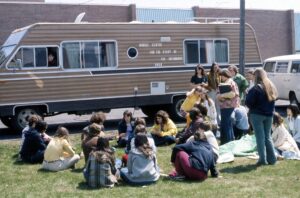
The Eco Van project saw a handful of UW-Green Bay students take to the road in a 24-foot Concord motorhome, where they would educate local communities and schools about environmental issues. The MSCE students, mostly environmental sciences majors, traveled to northeastern Wisconsin high schools. The van stayed in those communities for several days (and sometimes an entire week) to interact (“rap”) with the local students and residents about environmental issues and topics.
That same year, UW-Green Bay piloted another sustainability project–planting a garden. Barbara Rosenbaum, a student from Missouri, contacted the Office of Student Life wondering if there was a section of campus land that could be made available for a garden. Other students, faculty, and staff soon joined the efforts. Dick Christie, director of student life, made sure the gardening group received funding. Although the allocation was only $100, the group accomplished a great deal in the first year.
The garden consisted of a half-acre lot and was divided into a communal section and individual areas. The small organic campus garden grew cabbage, beans, corn, radishes, lettuce, and other vegetables. One of the organizers was Schellie Hensely, a senior from Illinois. According to campus records, the limited gardening funds were extended by using the leaf mold from a campus recycling project. Hensley stated the campus gardeners learned from organic gardening publications and members of the group who grew up on a farm; as well as intuition.
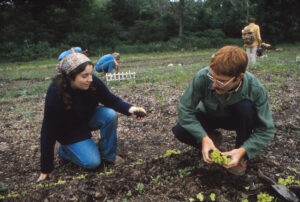
The 1973 garden quickly became bigger in purpose with the campus fruit trees benefitting from the garden mulching and pruning; planned renovation of the greenhouse; and the creation of a library on organic gardening. Fast forward to 2010, when the current Sustainable Local and Organic (SLO) Food Alliance was established and a new campus garden began on the plaza of the University Union.
“While the days of the ‘Eco Van’ are behind us, the legacy left by those students continues. Through the Master of Science in Biodiversity and Conservation Management, UW-Green Bay is continuing to make history as an ecologically- focused university committed to bettering the communities and the environment around us. Our impact will reach far beyond Wisconsin; we can make a difference on a national scale,” said John Katers, Dean of the College of Science, Engineering and Technology at UW-Green Bay. Katers received his bachelor’s degree in environmental science and master’s degree in environmental science and policy from ‘Eco U.’
Are you interested in making a difference? When you enroll in the Biodiversity Conservation and Management program, you can choose your own learning path by completing individual certificates, or three stackable credentials plus a capstone project to earn the master’s degree. As a graduate of the master’s degree program, you’ll be qualified to pursue leadership and management roles within nonprofit and government conservation organizations and other agencies within the biodiversity conservation field. You’ll learn the skills necessary to manage climate change, threatened and endangered species, restoration and remediation of environmental damages, and balancing multiple recreational uses, while integrating the human perspective through community engagement and culturally responsible conservation practices.
Contact an enrollment adviser today to learn more about which path is right for you.
Learn more about our 100% online degree and certificate programs.
Get Program Guide